Persistent South Pole coverage
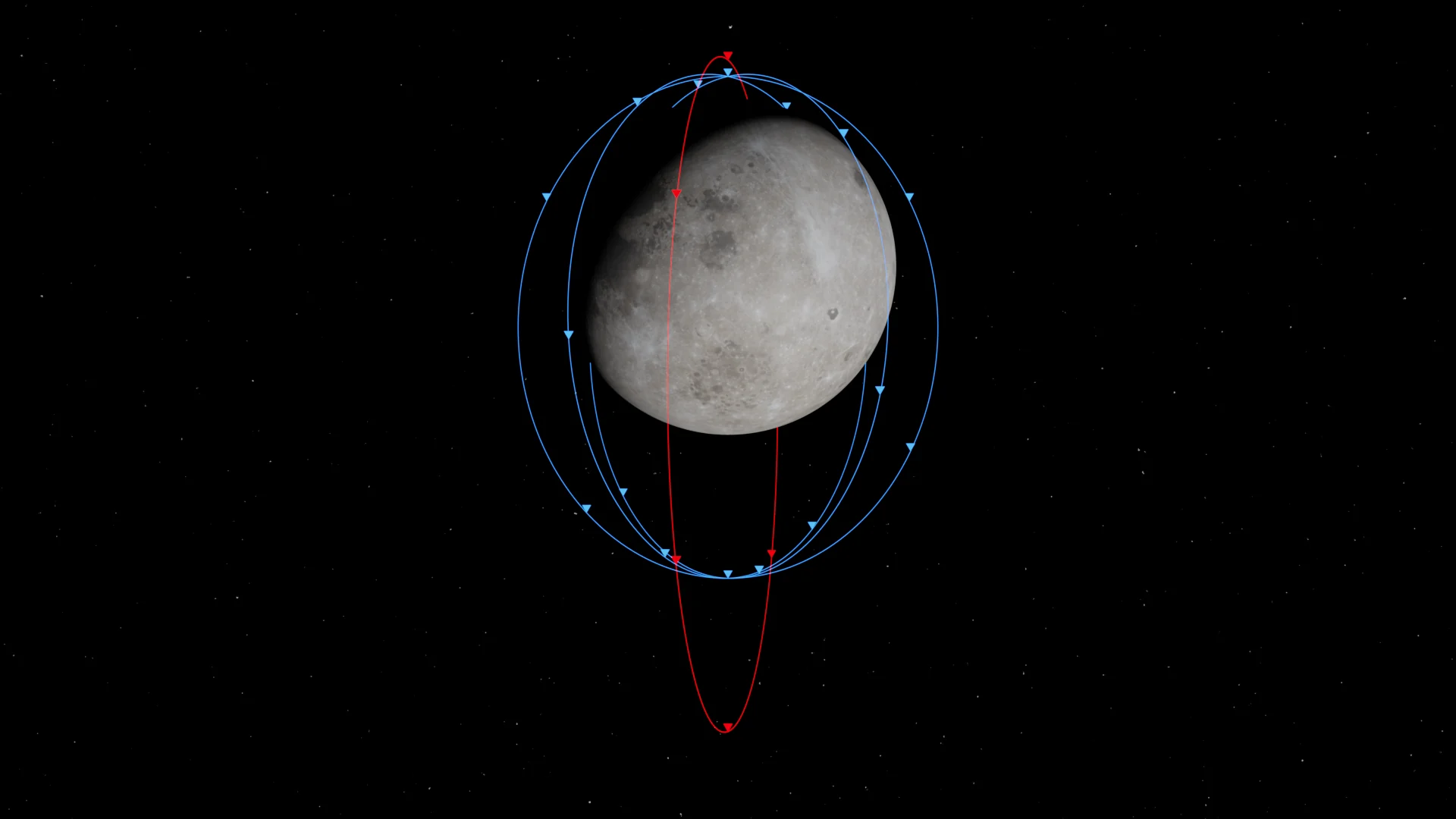
The baseline design targets at least three satellites available over the lunar South Pole at any given time.

NASA ORBIT Space Pathway · Sun Devil Orbital Systems · Arizona State University
Lunar Autonomous Navigation and Timing Relay Network
An 18-satellite constellation concept in highly elliptical lunar polar orbits, designed to provide persistent navigation and communications support for critical assets operating near the lunar South Pole.
Mission Need
The lunar South Pole is a high-priority region for future NASA exploration and sustained development, but crater rims, terrain masking, permanently shadowed regions, and limited visibility to Earth can interrupt direct connections to terrestrial assets.
Those interruptions can affect lander coordination, mission timing, astronaut tracking, rover operations, and emergency communications. Inertial navigation can bridge brief gaps, but its position estimates drift without regular external updates. LANTRN is intended to provide persistent local navigation and relay support without requiring continuous direct-to-Earth visibility.
Architecture
Each LANTRN satellite is conceived as a dual-purpose node. The constellation supports communications between mission control and lunar surface operations while enabling reverse-ephemeris navigation to estimate and update the positions of surface users.
The baseline design targets at least three satellites available over the lunar South Pole at any given time.
Known satellite states are used as measurement references so lunar surface users can estimate and regularly update their positions.
The network provides a local relay layer between lunar surface operations and mission control when direct Earth visibility is interrupted.
The concept is framed as an early infrastructure layer with room to expand to additional lunar regions and future destinations.
Project Media
All renders and motion studies below are conceptual project media supplied by the LANTRN team. Link lines, orbit colors, and camera movements are illustrative rather than operational telemetry.
Feasibility
According to the project abstract, feasibility was evaluated through thermal, mechanical, communications, and orbital trajectory analyses.
Long-duration spacecraft operation and environmental considerations.
Spacecraft configuration and structural concept development.
Relay support between lunar users, constellation nodes, and mission control.
Highly elliptical lunar polar orbit architecture for South Pole coverage.
Project Credits
Arizona State University · NASA ORBIT Space Pathway
Mason Davis
Eric Marcu
Kevin Ruiz Lopez
Elizabeth Thorley
Alexander Tavassoli
Joe DuBois
Primary Source
Sun Devil Orbital Systems, Arizona State University · NASA ORBIT Space Pathway · 2026